Android, in many hands.
Head of Design + Creative · Google · 2009–2014
How do you scale a computing platform when you don’t control the device?
A shared operating system could reach people through many manufacturers and carriers. But choice created another problem: developers needed dependable behavior, and people needed to recognize what those very different products had in common.
The reported numbers
| Date | Cumulative activations | Source |
|---|---|---|
| 100 million | Google ↗ | |
| More than 300 million | Google ↗ | |
| More than 400 million | Google ↗ | |
| More than 750 million | Google ↗ | |
| 900 million | Los Angeles Times · secondary report ↗ | |
| More than 1 billion | Engadget · secondary report ↗ |
In June 2014, Google reported over one billion active Android users ↗. That was a different measure: activity over 30 days ↗, not the cumulative number of devices activated.
- OEM partners
- 21
- Compatible models
- 60
- Carrier partners
- 59
- Countries
- 49
Two ways to coordinate a platform
What had to stay the same?
The public record suggests a system of bounded variation. Source code, compatibility, services and identity each had different rules. Openness did not mean that every layer was unrestricted.
- Source
- Source licenses
- Compatibility
- CDD + CTS
- Services
- Separate license
- Identity
- Robot / wordmark rules
Platform. Shared source leaves room for manufacturers, developers and carriers to shape different implementations.
Nexus S · custom operating systems · 2010
Platform
Android source gave manufacturers a shared starting point, with room for different devices and interfaces.
Shared source leaves room for manufacturers, developers and carriers to shape different implementations. Diagram roles: Manufacturers, Developers, Carriers.
Nexus S was designed to let enthusiasts install custom operating systems. Google documented that choice in December 2010.
Compatibility
The Compatibility Definition Document and Compatibility Test Suite set expectations for devices running Android SDK applications.
A common application contract connects different devices and the people building software for them. Diagram roles: Manufacturers, Developers, Carriers.
Google’s 2010 explanation allowed different hardware while requiring the platform’s application APIs to remain compatible.
Services
Google Play licensing was separate from compatibility. A compatible device did not automatically receive a license.
Manufacturers seeking to preinstall Google Play needed a separate license; device compatibility did not grant it automatically. Diagram roles: Manufacturers.
The compatibility documentation in the late-2012 source tree explicitly identifies legal and business conditions for Google Play licensing.
Identity
The green robot could be modified with CC BY 3.0 attribution. Google’s public app-promotion guidance separately restricted Android name and wordmark uses.
A shared character supports partner and personal expression, with separate rules for robot reuse and wordmark use. Diagram roles: Manufacturers, Developers, Carriers, People.
Androidify’s 2011 accessory updates made the shared character personal. The 2013 guidelines document different permissions for the robot and the wordmark.
Participation needs a path
- DesignPrinciples and patterns
- DevelopTraining, APIs and tools
- DistributePublishing and discovery
More to build on
Coherence was work, not a finished state. Google’s compatibility team acknowledged bugs and limits to test coverage. OpenSignal later observed 18,796 device types in a sample of 682,000 devices—evidence of diversity, not a complete product census. Google, 2010 · OpenSignal, 2014 report mirror
Recognizable, without being identical.
Android’s identity can be read as a brand protocol: enough shared signals to establish a relationship, enough room for someone else’s product, place or personality.
| Expression | Shared connection | Room for difference |
|---|---|---|
| HT-03A DOCOMO · HTC · Japan · 2009 | Android, Google services, Android Market | A Japanese carrier’s product family and service proposition. |
| myTouch 3G T-Mobile · HTC · US · 2009 | Google services and Android Market | Personalization, interchangeable looks, and help choosing in-store. |
| DROID Verizon · Motorola · US · 2009 | Android 2.0, apps, Google Maps Navigation | A carrier sub-brand with a machine-and-performance voice. |
| Nexus S Google · Samsung · US / UK · 2010 | Gingerbread’s lead device; Google experience | Samsung hardware in a product co-developed with Google. |
| Androidify Google Creative Lab · Larva Labs · 2011 | The Android character | People change the figure to resemble themselves. |
| Androidland Telstra · Google · Melbourne · 2011 | One Android retail experience | Samsung, HTC, Sony Ericsson, Motorola and LG products together. |
The promise needed an engineering basis.
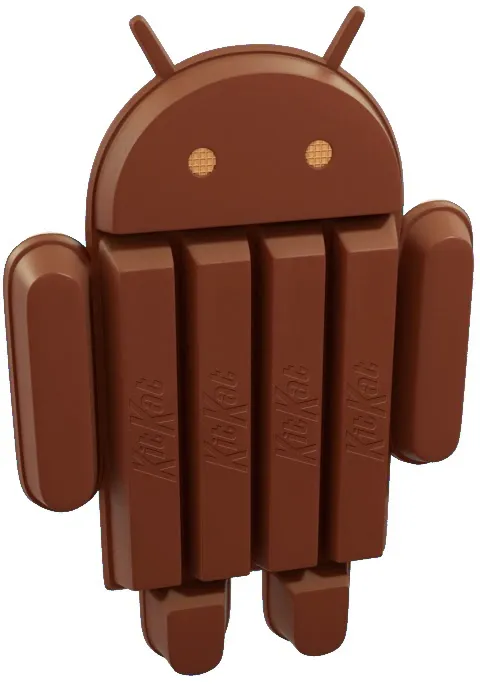
KitKat’s broader-reach story had a concrete mechanism: Project Svelte reduced Android’s memory requirements for devices with as little as 512 MB RAM. That made a wider range of hardware technically possible; it did not mean every eligible device received the update.